• HOME
  • WORKS
  • ABOUT
  • FOUNDATION
  • EXHIBITIONS
    • EXHIBITIONS
    • GALLERIES
  • CONTACT
  • FAQ
  • More
    • HOME
    • WORKS
    • ABOUT
    • FOUNDATION
    • EXHIBITIONS
      • EXHIBITIONS
      • GALLERIES
    • CONTACT
    • FAQ
  • HOME
  • WORKS
  • ABOUT
  • FOUNDATION
  • EXHIBITIONS
    • EXHIBITIONS
    • GALLERIES
  • CONTACT
  • FAQ

ALICIA HENRY

THE ARTIST

Alicia Henry was a multidisciplinary visual artist whose practice spanned drawing, textiles, assemblage, and installation, exploring the psychological and cultural dimensions of Black identity, visibility, and embodiment. Born in Chicago, Illinois, in 1966, Henry was shaped by the city’s rich intellectual and artistic legacy—from the aesthetic rigor of the Black Arts Movement to the socially engaged pedagogy of institutions like the School of the Art Institute of Chicago (BFA, 1989). She went on to earn her MFA from the Yale University School of Art in 1991, where she refined a conceptual and formal language grounded in layered abstraction and figurative restraint.


Henry’s career would defy easy categorization. Though trained in traditional disciplines, she gravitated toward hybrid modes of making that challenged the boundaries between craft and fine art, the personal and the political, the seen and the unseen. Her formative years were marked by critical residencies at Skowhegan, Yaddo, the Fine Arts Work Center, and MacDowell, where she began developing a visual vocabulary centered on repetition, distortion, and fragmentary human form.


For over two decades, she served as Associate Professor of Art at Fisk University—one of the oldest historically Black colleges in the U.S.—where she became a pivotal mentor, intellectual guide, and cultural custodian for generations of emerging artists. Her quiet, contemplative demeanor masked a fierce and unwavering commitment to truth, care, and artistic integrity.

THE WORK

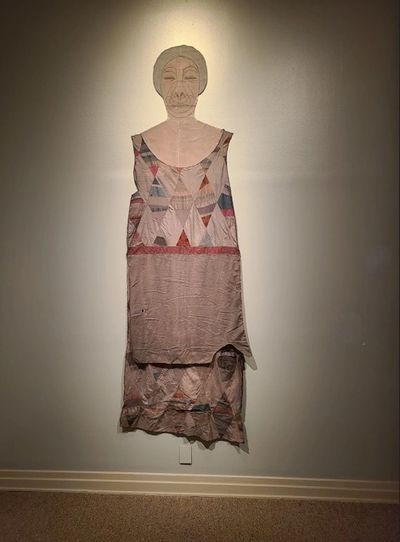
Henry’s work resists spectacle. Instead, it invites meditation—demanding patience, silence, and attentiveness. At the core of her practice was the symbolic human figure, rendered through cut fabric, stitched leather, dyed paper, thread, graphite, and shadow. These figures often lack facial features, or possess mask-like faces, existing somewhere between icon and phantom, person and archetype. Their anonymity is purposeful—they become vessels of collective memory and emotional residue, rather than individual portraits.


Her compositions—whether large-scale installations or intimate works on paper—often present groups of figures arranged in ritualistic or confrontational stances. They seem suspended between visibility and erasure, suggesting themes of mourning, resilience, and transhistorical presence. Henry's method of layering materials—ripping, sewing, staining, pinning—echoes the processes of psychological and cultural repair. Her use of textiles pays homage to African American quilting traditions, but the minimalist surfaces and haunting stillness place her work in dialogue with modernism, Afro-surrealism, and sacred geometry.


Series such as Witnessing (2019, The Power Plant, Toronto), Drawn in Stillness (Frist Art Museum, Nashville), and The House That Will Not Stand (Cheekwood, Nashville) exemplify her refined material sensitivity and emotional depth. The works—blackened silhouettes, dripping masks, and stitched outlines—ask the viewer to reconsider what it means to observe, remember, or be remembered.


Critics have described her work as “ethereal but weighted,” “modest in gesture yet monumental in effect,” and “the embodiment of historical reckoning through visual restraint.” Her figures do not shout. They whisper—yet their resonance is thunderous.


  • Exhibited at prestigious international institutions
  • Recipient of top-tier fellowships
  • Celebrated for her unique, emotionally resonant textile and mixed-media artwork
  • A respected educator and cultural influence


Her legacy endures in private collections, museums, galleries, and in the students she mentored.


Artistic Style & Themes


  • Material Speak: Henry masterfully blended dyed cotton, leather, felt, linen, burlap, wood, paper, charcoal, and thread—crafting layered wall hangings and sculptural installations that evoked texture, fragility, and depth.


  • Figuration & Masks: Her work often featured faceless or mask-like figures, drawing on West African mask traditions and symbolizing the layered and often hidden aspects of identity.


  • Themes Explored: Central to her practice were explorations of family dynamics, Black femininity, embodiment, race, visibility/invisibility, and intergenerational memory
IMPACT

Alicia Henry’s impact extends far beyond her studio walls. As an artist, she engaged in a life long practice of rehumanizing Black figuration. As a teacher, she shaped a lineage of artists who now carry her contemplative ethos into new realms. As a cultural steward, she centered care, ethics, and interiority in a field often obsessed with spectacle.


Henry was the recipient of numerous honors, including:


  • Guggenheim Fellowship (2000–2001)
  • Ford Foundation Fellowship (1989–1991)
  • Joan Mitchell Foundation Grant (2013)
  • Residencies at Skowhegan, MacDowell, and Yaddo 


Her works are held in private and public collections including the Studio Museum in Harlem, National Gallery of Art, and Frist Art Museum. She was exhibited at institutions across North America, Europe, and Australia, including the Whitney Museum of American Art, Carnegie Museum of Art, The Power Plant (Toronto), Art Gallery of Nova Scotia, and the Museum of Contemporary Art in Sydney.


In death, as in life, Alicia Henry’s art continues to function as a visual theology—centered on dignity, stillness, and spiritual excavation. Her legacy is not only what she made, but what she made possible: a space—layered, luminous, unresolved, and whole. 

©1972 – 2026 The Estate of Katie Henry.

All Rights Reserved.

This website uses cookies.

We use cookies to analyze website traffic and optimize your website experience. By accepting our use of cookies, your data will be aggregated with all other user data.

Accept